


Loading...

Track Listing
- 3:25
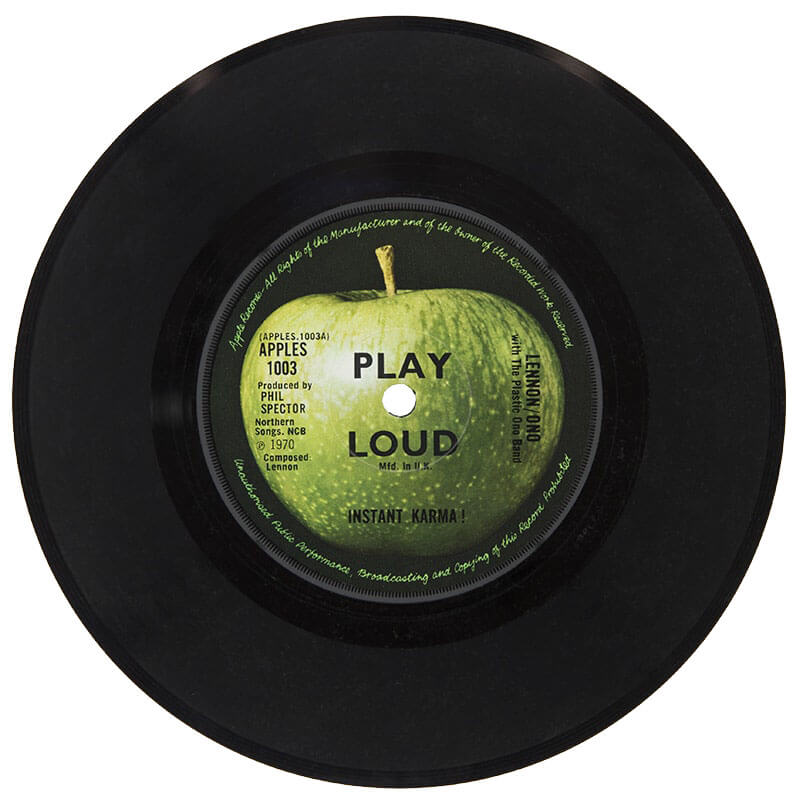
‘Instant Karma! (We All Shine On)’ is John’s 3rd single, it was written and recorded on 27th January 1970 and released just ten days later on February 6th.
The B-Side, ‘Who Has Seen The Wind’ was written by Yoko Ono.
‘I wrote it in the morning on the piano, like I said many times, and I went to the office and I sang it. I thought, “Hell, let’s do it”, and we booked the studio. And Phil came in, he said, “How do you want it?” I said, “You know, 1950 but now.” And he said “Right,” and boom, I did it in just about three goes. He played it back, and there it was. I said, “A bit more bass, that’s all.” And off we went. See, Phil doesn’t fuss about with fuckin’ stereo or all the bullshit. Just “Did it sound alright? Let’s have it.” It doesn’t matter whether something’s prominent or not prominent. If it sounds good to you as a layman or as a human, take it. Don’t bother whether this is like that or the quality of this. That suits me fine.’
– John Lennon, 1970
John: I wrote it for breakfast, recorded it for lunch and we’re putting it out for dinner.
George Harrison: John phoned me up one morning in January and said, ‘I’ve written this tune and I’m going to record it tonight and have it pressed, up and out tomorrow. That’s the whole point – ‘Instant Karma!’ – you know? So I was in. I said, ‘OK. I’ll see you in town.’ I was in town with Phil Spector said to Phil, ‘Why don’t you come to the session?’ There were just four people: John played piano, I played acoustic guitar, Klaus Voormann on bass and Alan White on drums. We recorded the song and brought it out that week; mixed, instantly, by Phil Spector.
John: It was great because I wrote it in the morning on the piano; went to the office and sang it; I thought, ‘Hell, let’s do it,’ and we booked the studio; Phil came in and said, ‘How do you want it?’ I said, ‘You know, 1950’s but now.’ And he said, ‘Right,’ and boom! I did it in just about three goes. He played it back, and there it was. I said, ‘A bit more bass’, that’s all. And off we went.
Andy Stephens (tape op): John kept trying to pull him to the fore. Spector stood back and didn’t volunteer or dictate much at all. Then Lennon really pulled him out: ‘C’mon, Phil!’ Once he got into his stride, it was like all hell breaking loose. Tape machines, tape loops, tape delays, echo chambers, you name it!
Alan White: I had an idea of what I wanted to do – one of those things where you are playing a rhythm, but when it comes to a drum break, you play in a different meter. It came naturally – and John said, ‘Alan, whatever you’re doing, keep doing it. It’s wonderful.’
Klaus Voormann: Alan White, now I knew he can play. He played wonderful drums. And we thought the tracks sounded good. We went into the control room, stood at the back and it started and it was so incredible. The sound was just like we had heard in the headphones but with all these incredible effects. Then I knew it, because I heard that sound and I thought, this is the Phil Spector sound. It’s very, very simple. He has got these effects on the pianos and these wavering sounds. The bass and the kick drum were completely clean. The voice was more or less clean So that was typical for Phil Spector. And I love Phil Spector. I loved him then. From then on, it was incredible. Beautiful. I loved it.
Alan White: I also played piano with a few people. Phil Spector wanted to have everything doubled up and made it sound like one. So it was John and myself on one piano and the other piano had Klaus playing, just layering all these different pianos and then he’d never put just one tambourine on a record; he had to have fifteen of them!
John: There were all sorts of strange people on the session. The whole of a London discotheque was singing on it and we used doormen and roadies and everybody to make the backing track and just to get that feel that we’re all in it together.
Billy Preston: John wanted some people to sing background, so I got in his Rolls Royce with Mal Evans and we went to the clubs and got everybody to ‘come on down!’ We had a great time.
Alan White: These people must have been drinking all night. They came in and I remember there was Klaus, myself and John conducting. I thought this is going to be a total mess, people are going to be out of tune, out of time, and anyhow, we went through one run-through and I went ‘Oh my god!’ We all looked at each other and we couldn’t believe it – they were all singing in time and in tune. We got that done within an hour and we had a huge backing but no-one went back to the club. That, too, was very instant about ‘Instant Karma!’.
John: Everybody was talking about karma all of a sudden, always going on about it, especially in the Sixties. And it occurred to me that karma is instant as well. The action/reaction is what it’s about. I’m fascinated by commercials and promotion as an art form, so instant karma was like instant coffee, except for presenting it in a new form. It’s like they say about karma: you have to come back and go through that thing again if you don’t get it right in this lifetime. Well, those laws that are ‘cosmically’ talked about apply down to the minutest detail of life.
‘Instant Karma’ is my way of saying it’s right. It’s not just some big cosmic thing, it’s also the small things like your life here and your relationship with the person you want to live and be with; there are laws governing that relationship, too. And you can either give up, halfway up the hill, and say,
‘I don’t want to climb this mountain, it’s too tough, I’m going to go back to the bottom and start again, or stick with it.’ And well, we were lucky enough to go through that, and come back and pick up where we left off, although it took us some kind of energy to get in the same synch again. It took some time.
Yoko: What the so-called leaders don’t understand is when they are saying ‘we should do this’, they are working out their own karma. There might be some need in them to be violent, or something like that, but you can’t really push that on other people; it’s a very sticky area. People should not get ticked off by a trend, or what they read in a book. They should trust their own instincts.
John: There are ones that didn’t follow their instincts and went to Vietnam and got killed, crippled and deformed and only woke up afterwards. They are the responsibility of the people who sent them there – who sent them there under an illusion.
John: Gandhi and Martin Luther King are great examples of fantastic non-violents who died violently. I can’t ever work that out. We’re pacifists, but I’m not sure. What does it mean when you’re such a pacifist that you get shot? I can never understand that.
John: Pain is what we’re frightened of. We all seem to think we have a secret. The secret is that we hurt because of lots of things that happened to us.
Klaus Voormann: I think we did two BBC TV Top Of The Pops performances. And there was a guy standing there playing with us, who played a bass, too.
John: B. P. Fallon playing the bass guitar, that’s concept art!
B. P. Fallon: I can’t play bass, but it’s better than whacking a tambourine into John’s left ear and almost putting him off his singing! [laughs]
Alan White: Purely the fact that John & Yoko were doing Top Of The Pops became a big spectacle. It was pretty amazing. Yoko was knitting, which was pretty weird. She had a Kotex blindfold on, for some of it. He loved her way of expressing her art and it seemed to be part of the music at that time.
John: I enjoyed the ‘Instant Karma!’ thing because there were the people right there. And we were talking about the fact that she was knitting. Because we did everything together. I’m doing ‘Instant Karma!’ with a backing tape with live vocals and she’s just sitting there knitting this scarf, and there was some review the next day – ‘How dare she sit there knitting?’ But we wanted to be together, and her contribution to that event, instead of having a smoke bomb, a coloured light or a psychedelic light, Yoko only knitted, you see? And… ‘What are they doing?!’
Yoko: Knitting is something very interesting. It’s almost like knitting a web of the mind. I was blindfolding myself with a Kotex and knitting something that was going nowhere, while a man symbolizing our future was singing, ‘We all shine on’. Yes, we will shine, but for that, we have to take the blindfold off and stop knitting, when we don’t know what we are knitting. It was my way of showing what we women must free ourselves from. The blindfold means to me everybody in the world is blind and trying their best.
John: The thing is that if ‘Instant Karma!’ is in the charts and Plastic Ono Band is everyone, you’re all in the charts. That’s the feeling we want to get over. So Yoko was knitting, there was some guy pretending to play bass and things like that and anybody can be on the session.