





Loading...
Track Listing
- 4:53
- 4:03
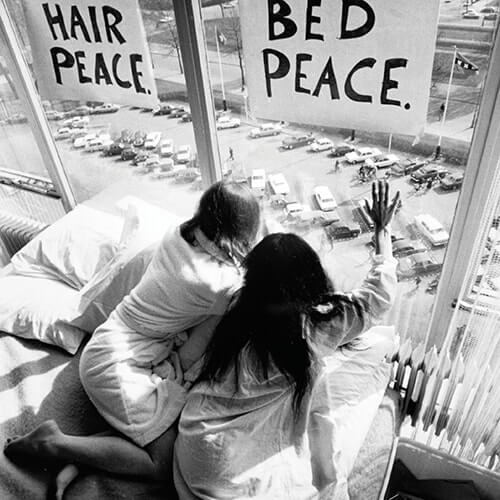
‘Give Peace A Chance’ was recorded on June 1st and 2nd in room 1742 of the Queen Elizabeth Hotel in Montreal, Canada during John & Yoko’s second Bed-In for Peace. The B-Side, ‘Remember Love’ is a song written by Yoko and recorded in the same room.
Released on July 4th 1969 it is John’s first single recorded without the involvement of any other Beatles, it reached No. 2 in the UK singles charts.
‘It wasn’t like “You have to have peace!” Just give it a chance. We ain’t giving any gospel here – just saying how about this version for a change? We think we have the right to have a say in the future. And we think the future is made in your mind.’
– John Lennon, 1980
John: I get angry and that’s aggression and I feel like jumping on something. I feel like knocking my head against a wall. All the time I feel, ‘Don’t shake your fists at a building, students, because a building isn’t it. Go to Number 10 [Downing Street, the Prime Minister’s house] and kick the windows in.
That inability to cope with it, it’s so big, such a big fight that we’re in, that it overpowers you and you get lulled by the TV and the papers and your hit records or your love, and then you suddenly remember again, ‘God al- mighty!’ Then you get angry and then you do something again.
On the peace campaign, when we are in the middle of those things,there’s not a moment that we’re not aware of it because we’re talking to the press every day and we have to answer.
After them, we go through a depression, because it’s an event or a performance: ‘Was it worth it? What were we doing? What were the motives? Was it effective?’ And then somebody comes up and says, ‘What about Biafra? What about this and that?’ And we have to start coming out of our shell again and doing another performance and relive our initial anger that made us go out and do those Bed Events.

The point of the Bed-In was a commercial for peace, as opposed to a commercial for war, which was on the news every day – dismembered bodies and napalm. And we thought, ‘Well, why don’t they have something nice in the newspapers?’
We tried to do it in New York, but the American government wouldn’t let us in. They knew we’d done it in Amsterdam; they ‘didn’t want any peaceniks here’. We ended up doing it in Montreal instead, and broadcast it across the border.
We enjoyed the Bed-Ins and the seven days talking to the reporters was hilarious. Seven days. Ask anything. No secrets. No time limit. Come in as long as you like until you’ve got everything you need to know about John & Yoko and what we stand for.
They all came charging through the door, thinking we were going to be screwing in bed. And of course, we were just sitting there with peace signs! It didn’t matter what the reporters said, because our commercial went out irrespective.
After answering all these questions many, many times, it got down to all we were saying was ‘give peace a chance’. Not ‘we have a formula’, or ‘communism or socialism will answer it’, or ‘any -ism could answer it’.
We didn’t have a format. We couldn’t give you a plan. But just consider the idea of not having this war. Just consider it. So that’s what we were saying. We recorded it in the bedroom of the Montreal Hilton.
Whenever we have the press in, we always have the word PEACE there.
It’s that subtle, that kind of subliminal message. When kids see me now, they do the peace sign. We used it all the time because it seemed to be in fashion wherever we went.
I refuse to be a leader, and I’ll always show my genitals or do something which prevents me from being Martin Luther King or Gandhi and getting killed. Because that’s what happens to leaders. Our whole mistake is having leaders and people we can rely on or point a finger at.
Like Pete Seeger said [at the Vietnam Moratorium, when he sang ‘Give Peace A Chance’ with half a million protestors], we don’t have a leader, but we have a song: ‘Give Peace A Chance’.
I was pleased when the movement in America took up ‘Give Peace A Chance’ because I had written it with that in mind. I hoped that instead of singing ‘We Shall Overcome’, they would have something contemporary.
I felt an obligation even then to write a song that people would sing in the pub, or on a demonstration. I remember hearing them all sing it — I don’t know whether it was on the radio or TV — it was a very big moment for me. That’s what the song was about.
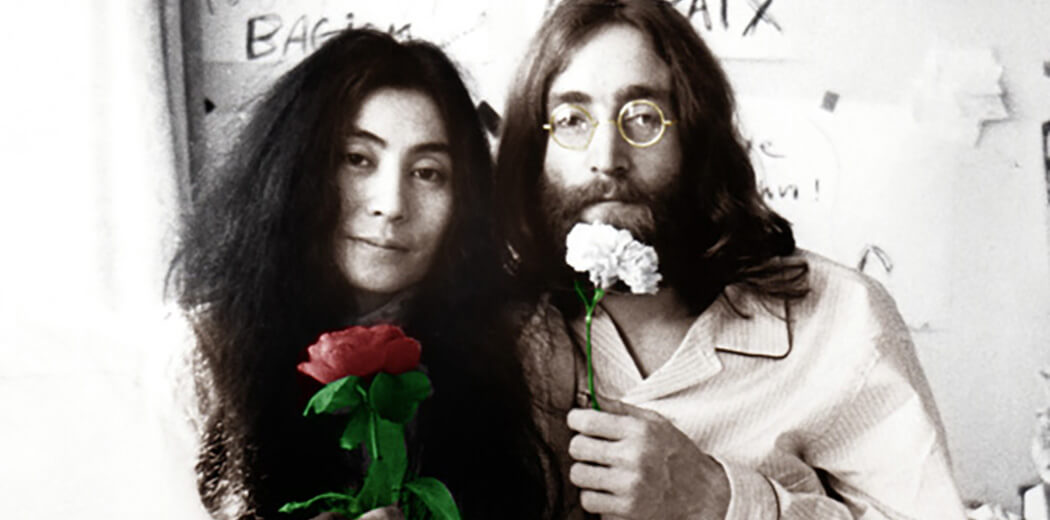
Yoko: All those Vietnam protests really changed the world. There was always that element who were really resisting it. That was the saving grace – that people were aware that they were that young generation who were really against it. And so it worked very well for the world. The Bed-In was just part of it, a definite part of it. It was a statement on a very theatrical level and I think it was very effective.
We were artists and did it our own way. We felt very good about it then, and it was such an incredibly strange thing that we were doing. At the time it was a courageous thing to do. John was making the statement in a way that he was looking at the far, far future. I saw it in his eyes. He was saying, ‘OK this is what we’re going to do together.’ And we’re going to give peace a chance. To the world.
John: It wasn’t like, ‘You have to have peace!’ Just give it a chance. We ain’t giving any gospel here, just saying, ‘How about this version for a change?’ We think we have the right to have a say in the future. And we think the future is made in your mind.
Yoko: Many people say if you want to do that kind of thing about peace, don’t do anything that is misleading, like showing your genitals. Always keep a clean image so that people can believe in your peace movement. But that’s exactly what the Establishment is doing…
John: And that’s what the Beatles did, too!

Yoko: …taking their children to church on Sundays. This is to show that ‘I’m the President of the United States and I’m alright and I’m healthy and very moral, etcetera.’ You don’t get anywhere that way. You become just another hypocrite, and you’re playing the Establishment game. We don’t want to do that. We try to be honest.
And the point is, if we are really honest, just to make it between us is a lifetime thing. And if we can’t make it together and endure each other, the world is nowhere.
John: It’s got to start with yourself. It’s got to start on a family basis and your neighbour. It can’t be an overnight, worldwide turn-on. There’s no man in the sky going to come out and zap us out, so we’ve got to start it locally like that.
Yoko: If ordinary couples can make it together and make it with their children and so forth, love-wise, then you can look after the world.
John: All this crap about the people being given the power by a group of revolutionaries is rubbish. The people have the power now. And if we can’t remember it ourselves, how can we expect all the other people to remember it? Peace is an alternative. You can have it if you want it, because the people have the power.
Timothy Leary: In the twenty-first century, as we look back at the wild and woolly twentieth century, I think the legend of John & Yoko will stand out as something great. The fusion of an Oriental woman and a Western man; an upper-class woman and a working-class boy. Yoko was Fifties, John was Sixties. I think there are millions of people that are going to benefit from what they did.


