





Loading...

Track Listing
- 5:04
- 4:55
‘Cold Turkey’ is John’s second solo single released with The Plastic Ono Band, it was released on 20th October 1969.
The B-Side is Yoko’s ‘Don’t Worry Kyoko (Mummy’s Only Looking For A Hand In The Snow)’ written for her daughter, Kyoko.
‘Cold Turkey is self-explanatory. It was banned again all over the American radio, so it never got off the ground. They were thinking I was promoting heroin, but instead… They’re so stupid about drugs! They’re always arresting smugglers or kids with a few joints in their pocket. They never face the reality. They’re not looking at the cause of the drug problem. Why is everybody taking drugs? To escape from what? Is life so terrible? Do we live in such a terrible situation that we can’t do anything about it without reinforcement from alcohol or tobacco or sleeping pills? I’m not preaching about ‘em. I’m just saying a drug is a drug, you know. Why we take them is important, not who’s selling it to whom on the corner.’
– John Lennon, 1980
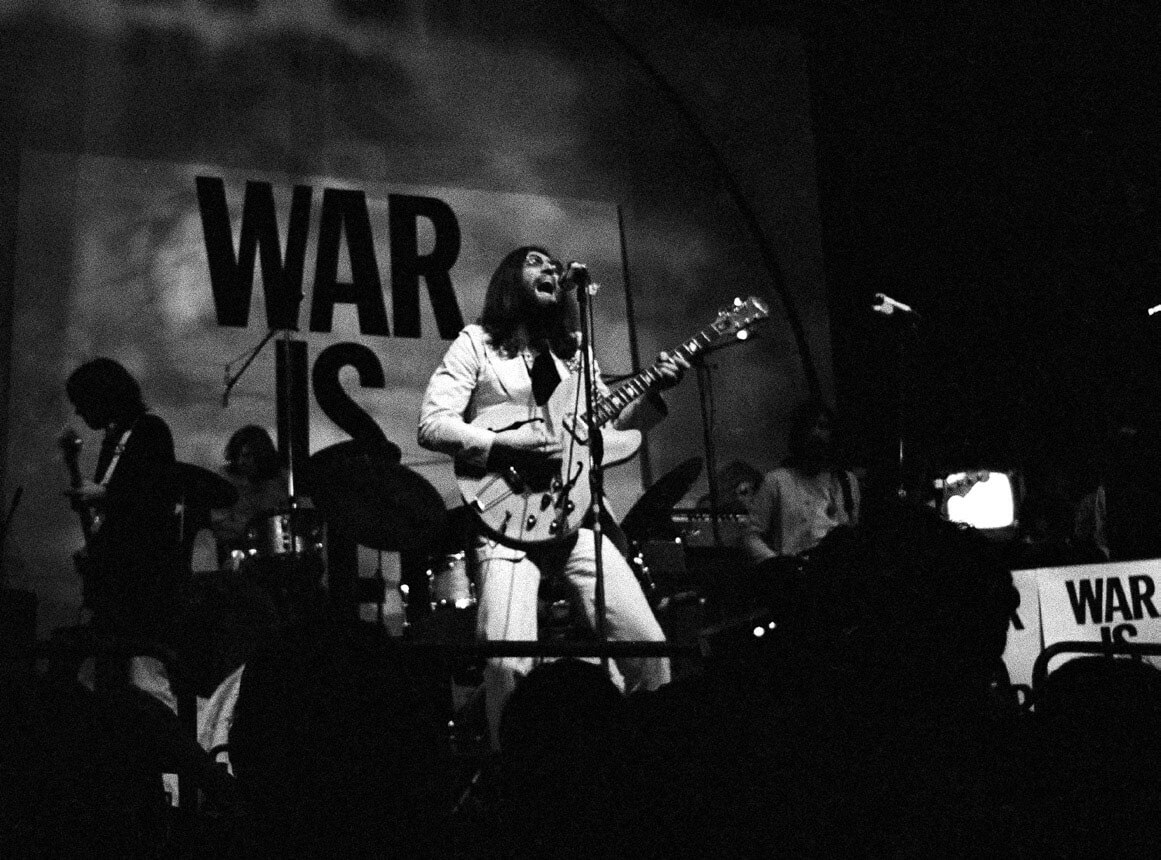
John: I announced ‘Cold Turkey’ at the Lyceum saying, ‘I’m going to sing a song about pain.’ So pain and screaming was before Janov. Janov showed me more of my own pain. I went through therapy with him and I’m probably looser all over.
Arthur Janov (therapist): if you think about the amount of drugs John took, could you imagine what that would do to a person? John had the kind of pain that would knock a patient off the floor, it was so catastrophic. When he was in pain, it was agony beyond description.
John: ‘Cold Turkey’ is self-explanatory. It was the result of experiencing cold turkey withdrawals from heroin. Everybody goes through a bit of agony some time or another in their lives, whatever it is. ‘Cold Turkey’ is just an expression that is suitable to explain the other side of life. I’m always thinking about love and peace, and now I’m thinking about agony – to remind people that I’m human and that we suffer like everybody else. This is the after effects.
In the beginning it was a constant fight between Brian [Epstein] and Paul on one side, and me and George on the other. Brian put us in neat suits and shirts and Paul was right behind him. I didn’t dig that and I used to try and get George to rebel with me. I’d say to him, ‘Look, we don’t need these suits. Let’s chuck them out of the window.’ My little rebellion was to have my tie loose, with the top button of my shirt undone, but Paul would always come up to me and put it straight.
I saw a film the other night, the first television film we ever did. The Granada people came down to film us, and there we were in suits and everything. It just wasn’t us. And watching that film I knew that that was where we started to sell out. We had to do a lot of selling out then.
We had to go through humiliation upon humiliation with the middle classes and showbiz and Lord Mayors and all that. They were so condescending and stupid. Everybody trying to use us. It was a special humiliation for me because I could never keep my mouth shut and I’d always have to be drunk or pilled to counteract this pressure.
Taking the MBE was a sell-out for me. You know, before you get an MBE, the Palace writes to you to ask if you’re going to accept it, because you’re not supposed to reject it publicly and they sound you out first. I chucked the letter in with all the fan-mail, until Brian asked me if I had it. He and a few other people persuaded me that it was in our interests to take it, and it was hypocritical of me to accept it. But I’m glad, really, that I did accept it, because it meant that four years later I could use it to make a gesture.
We did manage to refuse all sorts of things that people don’t know about. For instance, we did the Royal Variety Show once, and we were asked discreetly to do it every year after that—but we always said ‘stuff it.’ So every year there was always a story in the newspapers saying: ‘Why No Beatles For The Queen?’ which was pretty funny, because they didn’t know we’d refused it.
That show’s a bad gig anyway. Everybody’s very nervous and uptight and nobody performs well. The time we did do it, I cracked a joke on stage: ‘For our last number I’d like to ask your help – would the people in the cheaper seats clap your hands… and the rest of you, if you’d just rattle your jewellery.’
I was fantastically nervous, but I wanted to say something, just to rebel a bit, and that was the best I could do.
I dug the fame, the power, the money, and playing to big crowds. Conquering America was the best thing. You see, we wanted to be bigger than Elvis. That was the main thing. At first we wanted to be Goffin and King, then we wanted to be Eddie Cochran, then we wanted to be Buddy Holly, and finally we arrived at wanting to be bigger than the biggest. And that was Elvis.
We reckoned we could make it because there were four of us. None of us would’ve made it alone, because Paul wasn’t quite strong enough, I didn’t have enough girl appeal, George was too quiet, and Ringo was the drummer. But we thought that everyone would be able to dig at least one of us, and that’s how it turned out.
‘Cold Turkey’ is an especially important record for me because it’s my record. When I wrote it I went to the other three Beatles and said, ‘Hey lads, I think I’ve written a new single.’ But they all said ‘Um, ah, well…’, because it was going to be my project.
So I thought, ‘Bugger you! I’ll put it out myself.’

Your Majesty, I am returning my MBE in protest against Britain’s involvement in the Nigeria-Biafra thing, against our support of America in Vietnam and against ‘Cold Turkey’ slipping down the charts. With love, John Lennon of Bag.
As a protest against violence and war, especially Britain’s involvement in Biafra, which most of the British public are not aware of, because all the press, TV and radios slant all the news from Biafra.
All the stuff I learned on Biafra from journalists off the cuff, folks, is a different story and I began to be ashamed of being British – and I’m a patriotic nationalist if the truth were out, and Yoko can vouch for that – I’m always fighting about what Britain invented – radar and all the different things we’ve done.
But every day I just began to worry a bit more about it and I was going to send the MBE back anyway. I could have done it privately, but the press would have found out anyway — you would have been here a week later instead – less impact.
The Biafran public relations people said it was of great use. Bertrand Russell thought it was of great use. The people of Biafra thanked me for doing that, and that’s enough. They want all the publicity they can get.
It doesn’t matter if I’ve given the MBE back. Technically I’ll always be an MBE. That’s like I’ll always be a Beatle.
Just say I hadn’t put that line on my letter about ‘Cold Turkey’ dropping down the charts. What would they have attacked? And they’re going to attack, man, whatever.
If it hadn’t have been ‘Cold Turkey’, the whole concentration would have been on insulting Her Majesty. Instead they printed what I had to say in the letter. Most journalists wrote about how my aunty felt about my MBE rather than peace in Biafra. That’s their whole game: prejudice and fear. They were frightened of committing themselves, and rather than being conned by the entertainer, they’d sooner divert their attention to something irrelevant. But what’s important: the MBE, Biafra, Vietnam or Aunt Mimi’s feelings?
And anyway, it’s not that serious. Our whole game is to say to people that war itself is a game that’s gone too far. The problem with the revolutionaries is that they get so serious, so involved, that they’re now playing the politician and the Establishment’s game. You don’t win like that. We think that was the mistake that Gandhi and Martin Luther King made by becoming The Leader and The Saint and The Holy Man who Does No Wrong.
Nobody likes saints alive. They like them dead. And we don’t intend to be dead saints. We’d rather be living freaks.


